Florida Non Resident Fishing License: Pick the Right License Before You Cast
Visiting Florida? Start with three choices: freshwater or saltwater, 3-day/7-day or annual, online or in-person. A home-state license does not work in Florida, and most nonresidents age 16 or older need a Florida license before fishing unless a clear FWC exemption applies.
Fast rule: annual nonresident freshwater and saltwater licenses can be bought online. Current FWC guidance says nonresident 3-day and 7-day recreational fishing licenses are not available online, so short-trip visitors should plan an in-person license-agent or tax-collector stop before fishing.
Choose Your Florida Nonresident License Route
This is the easiest way to avoid buying the wrong license. Read left to right: water type, trip length, purchase method, then proof.
Official Facts Used in This Refresh
Florida Nonresident Fishing License Rules Visitors Must Know
FWC says nonresidents age 16 or older need Florida licenses and permits to take or attempt to take freshwater or saltwater fish unless an exemption applies. “Attempt to take” matters because catch-and-release fishing can still require a license.
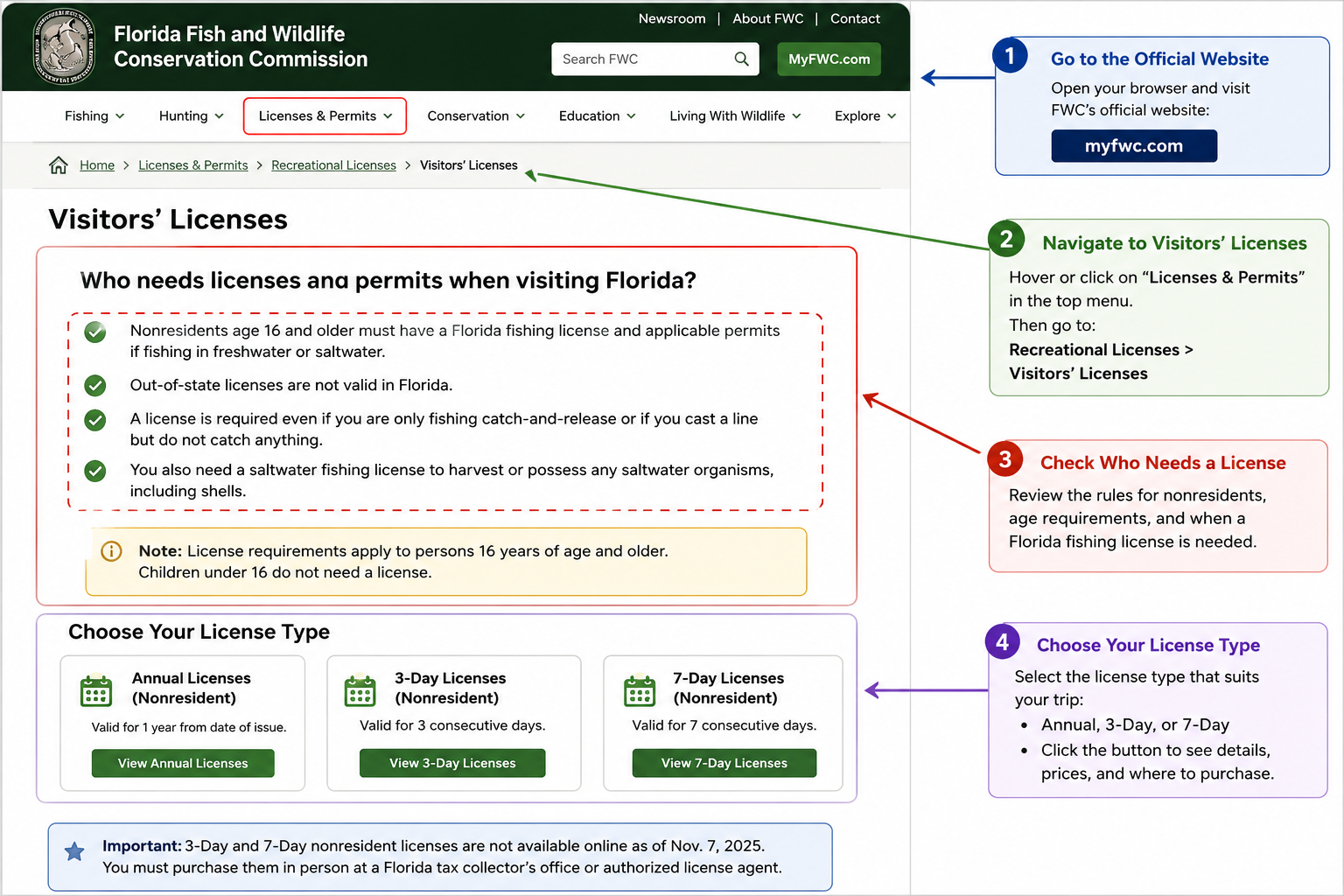
Visual Guide: What Visitors Should Check on the FWC Page
This image belongs near the top because it explains the first questions in the user’s mind: where to start, who needs a license, what age rule applies, and whether 3-day or 7-day licenses are online.
Florida Nonresident Fishing License Price in 2026
FWC lists the same base nonresident prices for freshwater and saltwater recreational licenses. Extra permits, tags, registrations, vendor fees or agent fees can change the final cost.
| Visitor plan | Likely license | Base price | What to check before paying |
|---|---|---|---|
| One lake or freshwater canal day | Nonresident 3-day freshwater | $17 | Buy in person; verify freshwater waterbody and dates. |
| One beach, bridge or pier day | Nonresident 3-day saltwater | $17 | Buy in person unless a charter/pier exemption clearly covers you. |
| Seven-day Florida vacation | Nonresident 7-day freshwater or saltwater | $30 | Plan in-person purchase before the first fishing hour. |
| Multiple Florida trips | Nonresident annual freshwater or saltwater | $47 | Annual is online-friendly through Go Outdoors Florida. |
| Lake and beach in same trip | Freshwater plus saltwater coverage | Depends on products | Check both water types; one license category may not cover both. |
Nonresident Florida Fishing License Online Rule
This is the main update visitors need to understand. Annual nonresident recreational fishing licenses remain online-friendly, but current FWC guidance says nonresident 3-day and 7-day recreational fishing licenses are no longer available online.
Decision Table: If You Need This, Do This
| Your situation | Best next action | Why it matters |
|---|---|---|
| I need a license today and I am fishing for only 1–3 days | Find an approved in-person license agent or tax collector. | Short-term nonresident licenses are not online under current guidance. |
| I want to buy from my hotel or home computer | Choose the annual nonresident license if it fits your trip. | Annual nonresident licenses can be bought online. |
| I am fishing both a lake and the beach | Check both freshwater and saltwater coverage before paying. | Florida separates freshwater and saltwater licenses. |
| I am a senior from another state | Check nonresident rules, not Florida resident senior rules. | Florida resident senior exemptions do not automatically apply to visitors. |
| I am going on a charter or licensed pier | Ask the operator whether their license covers your exact trip. | Coverage depends on vessel, pier, operator, species and activity. |
Freshwater vs Saltwater: The Simple Florida Rule
Florida visitor confusion usually starts here. A freshwater license is for freshwater fishing. A saltwater license is for saltwater fishing. Some coastal canals, bridges, rivers and mixed areas can be confusing, so verify by waterbody and target species before buying.
How to Buy the Right Florida Nonresident Fishing License
- Write your exact fishing plan. Note city, waterbody, date, freshwater/saltwater, shore/boat/pier/charter and target species.
- Check the FWC visitor rule first. Confirm whether you need a license or whether a specific exemption applies.
- Choose freshwater, saltwater or both. Do not buy based only on price. Buy based on where and how you will fish.
- Choose 3-day, 7-day or annual. Short-term saves money for short trips, but annual is the easier online route.
- Use the correct purchase route. Buy annual licenses online through Go Outdoors Florida. Use tax collectors or approved agents for short-term nonresident licenses.
- Add permits, tags or designations if needed. Check snook, lobster, reef fish, shore-based shark, tarpon, crab traps and species rules.
- Save proof before fishing. Keep digital proof, printed proof, receipt, confirmation number and permit details accessible without strong phone service.
Florida 3-Day and 7-Day Nonresident Licenses
The 3-day and 7-day options are made for visitor trips. They are helpful for weekend vacations, beach trips, family travel, pier fishing, quick lake trips and one-week stays. The catch is purchase method: plan the in-person stop before fishing time.
Florida Annual Nonresident Fishing License Online
The annual nonresident license is useful for snowbirds, seasonal visitors, repeat vacationers, anglers with family in Florida, longer stays and anyone who wants the simplest online buying route.
Florida Nonresident Fishing License Age, Seniors and Children
Florida age and senior rules are easy to misunderstand. Resident senior exemptions and visitor rules are not the same.
| Person | What usually applies | Plain warning |
|---|---|---|
| Nonresident age 16+ | Needs Florida freshwater or saltwater license unless an official exemption applies. | Home-state license is not valid in Florida. |
| Child under 16 | FWC lists children under 16 as not needing recreational licenses and permits. | Seasons, size limits, bag limits and gear rules still apply. |
| Out-of-state senior | Usually treated as a nonresident unless a specific exemption applies. | Do not use Florida resident senior rules as a visitor. |
| Florida resident senior 65+ | Resident exemption may apply with proof of age and Florida residency. | This is not the same as a nonresident senior exemption. |
Free Fishing License Florida: License-Free Days for Visitors
Florida has license-free fishing days. FWC says the recreational fishing license requirement is waived for all recreational anglers, including residents and nonresidents, on those days. This is not a permanent free license and it does not remove fishing regulations.
Charters, Party Boats, Piers and Shore Fishing
Some charter, party boat, vessel and licensed pier situations may cover recreational license requirements for customers. Visitors should confirm before the trip because coverage depends on the operator license, vessel, pier, activity, species and harvest plan.
Extra Florida Permits and Designations Visitors Should Check
A Florida fishing license may not be the only step. Saltwater visitors especially should check special species permits, tags, designations and education requirements before fishing.
License Proof, App and Reprint Tips for Visitors
Common Florida Nonresident Fishing License Mistakes
If You Cannot Buy or Find the License You Need
| Problem | Best fix | Do not do this |
|---|---|---|
| 3-day or 7-day not showing online | Use the Go Outdoors Florida agent locator or a tax collector office route. | Do not assume the short-term license no longer exists. |
| Unsure freshwater or saltwater | Check FWC rules for your waterbody, species and method before buying. | Do not pick the cheapest license first. |
| Agent location closed | Call nearby license agents, tax collector offices, bait shops or sporting-goods counters before driving. | Do not fish while “planning to buy later.” |
| Proof lost | Log in to Go Outdoors Florida or contact the seller route used for purchase. | Do not rely on memory of purchase. |
| Payment failed | Check whether the card was charged, save error messages, and contact the official purchase route. | Do not submit repeated payments without checking your bank activity. |
Find a Florida License Agent for 3-Day or 7-Day Licenses
Use this map as a planning helper for nearby license-agent searches. For the official list, use the Go Outdoors Florida agent locator and call before driving. Ask whether the location sells the exact nonresident freshwater or saltwater 3-day/7-day license you need today.
FWC Contact, Headquarters Address and Map
Official Florida Nonresident Fishing License Links
Use for nonresident age, out-of-state license, catch-and-release and exemption basics.
Open FWC visitor rulesUse for eligible annual online license buying, account access and license proof.
Open Go Outdoors FloridaUse for short-term 3-day and 7-day nonresident license buying locations.
Find license agentsUse to verify nonresident freshwater annual, 3-day and 7-day prices.
Check freshwater feesUse to verify nonresident saltwater prices and special permit details.
Check saltwater feesUse to verify freshwater and saltwater license-free fishing day schedules.
Check free fishing daysRelated Internal Link Note
No related internal post was added because the live post sitemap could not be verified during this refresh. To avoid fake or unverified links, add only sitemap-confirmed FishingLicenseGuide.org URLs later.
Florida Nonresident Fishing License FAQs
How much is a Florida nonresident fishing license in 2026?
FWC lists nonresident annual freshwater and saltwater licenses at $47 each. Nonresident 3-day freshwater and saltwater licenses are $17 each, and nonresident 7-day freshwater and saltwater licenses are $30 each. Extra permits, tags, vendor fees or agent fees may affect the final total.
Can nonresidents buy a Florida fishing license online?
Nonresidents can buy annual recreational fishing licenses online through Go Outdoors Florida. Current FWC guidance says nonresident 3-day and 7-day recreational fishing licenses are no longer available online and must be bought in person.
Where can I buy a Florida 3-day or 7-day nonresident fishing license?
Use a Florida tax collector office or approved in-person license agent location. Check the Go Outdoors Florida agent locator and call before driving to confirm the location sells the exact short-term freshwater or saltwater license you need.
Can I use my out-of-state fishing license in Florida?
No. FWC says out-of-state fishing and hunting licenses are not valid in Florida. Visitors need a Florida license unless a Florida exemption applies.
Do I need a Florida license for catch-and-release fishing?
Usually yes unless exempt. FWC says a fishing license is required to attempt to take fish. If you cast a line or catch and release, you need a license unless an official exemption applies.
What age needs a Florida nonresident fishing license?
Nonresidents who are 16 years of age or older generally need Florida licenses and permits for freshwater or saltwater fishing. FWC lists children under 16 as not needing recreational licenses and permits.
Do nonresident seniors get a free Florida fishing license?
Not just because they are seniors. Florida resident senior exemptions are different from visitor rules. Out-of-state seniors should verify directly with FWC before fishing without a license.
Does a Florida freshwater license cover saltwater fishing?
No. Freshwater and saltwater licenses are separate categories unless you have a specific combination or coverage that applies. Visitors should match the license to the water, species and fishing method.
Are Florida license-free fishing days for nonresidents too?
Yes. FWC says the fishing license requirement is waived for all recreational anglers, including residents and nonresidents, on license-free fishing days. All other seasons, bag limits, size limits and rules still apply.
Does a Florida charter cover my nonresident fishing license?
Some properly licensed charter, guide, party boat, vessel or pier situations may cover anglers, but you must ask the operator before fishing. Confirm coverage for your exact trip, species and harvest plan.
Do nonresidents need extra Florida saltwater permits?
Possibly. Snook, spiny lobster, reef fish from a private vessel, shore-based shark fishing, tarpon and trap activity can require extra permits, tags, designations, registrations or education steps.
What proof should I keep after buying a Florida fishing license?
Save your license record, receipt, confirmation number and any permit proof before fishing. Keep a screenshot or printed backup in case your phone battery dies, signal is weak or the license counter receipt gets wet.
Before You Fish in Florida as a Nonresident
For most visitors, the safest workflow is simple: check FWC visitor rules, choose freshwater or saltwater, choose 3-day, 7-day or annual, use the correct online or in-person route, add any special permit, then save proof before you cast.